What happened to light bulbs being US made? - Part 1
I hope you buy and enjoy Web of Deceit, a fictional novel about how the dot.com boom created both opportunity and disaster for one dishonest entrepreneur. Below is an account of another industry and how it dealt with the paradigm shift of how it competed for over 100 years.
Part One of Two: What happened to light bulbs being US made?
Most of you are too young to know that the light bulb industry in the 1970’s and 1980’s consisted of three suppliers: General Electric, Sylvania Lighting and Westinghouse (bought by Philips). The fascinating thing about these companies was that they were all vertically integrated.
What is vertically integrated? I’ll speak for Sylvania, since I worked for them for 30 years. Sylvania had manufacturing plants that made nothing but glass envelopes for incandescent, fluorescent or high intensity discharge lamps (think parking lots and streetlights). They also had metallurgical plants that included tungsten, molybdenum. They also had various other plants, making things like bases for light bulbs. These plants produced for some other uses too, but most of the sales from these plants were for making light bulbs.
For years, 90+% of light bulbs sold in the US came through one of these three companies. Even if you bought from Supreme or Feit, those products were produced by one of the big three. Despite some fluctuations in sales, generally GE led the US in market share. This was mostly due to the consumer industry. Sylvania was second, but first among the industrial and commercial markets.
In the late 1980’s and early 1990’s a few other manufacturers showed up. One, being OSRAM. Eventually OSRAM would buy Sylvania to consolidate to three companies again. Most of the new players concentrated on compact fluorescent products, as they were gaining in popularity for their energy savings and because utilities were pushing them on their rebate programs.
There were some clear benefits to making a career out of selling light bulbs:
(1) You didn’t have to be a nuclear scientist to understand the product
(2) You never ran into a customer who didn’t need light bulbs
(3) And no customer ever cares as much, or knew as much as you in selling it.
Light bulbs, like any products in the marketplace, evolve over time. But because light bulbs already had sockets in every business and household, change was slow and almost unnoticeable. For instance, mercury is a heavy metal and is a catalyst in starting a fluorescent lamp. Over time, we developed ways to use less mercury in a lamp. Exciting, it was not.
In the early 2000’s our laboratories were working on what they called solid state lighting. In other words, LEDs (light emitting diodes). LEDs had existed for many years, but mostly they were used in electronics as indicator lights. They lasted forever but were hardly bright enough to use for general lighting applications.
I was assigned to a task team to explore LEDs and determine how LEDs could become an important ingredient for lighting and how long this would take. Our team reviewed the research and soon realized that LEDs would be a transformative technology. It would change everything we took for granted in lighting.
For instance, the lighting fixture market depended on the light bulb performance and configuration to determine how to make their product. Often, the fixture manufacturer would buy our light bulbs to bundle with their fixtures. Their expertise was in spreading the light we produced.
It took a long time for us to convince our management team that the fixture companies would soon be able to take LEDs and integrate them into their products. The term light bulb would become obsolete for many fixtures.
If you look at automobiles today, you see all sorts of different head light configurations and taillights. LEDs are used because these small diodes can be made to function in almost any color you need. And you can wire up harnesses to spread the LEDs any way you want. You no longer must screw it into the harness. In the last thirty years, the automobile has gone from having incandescent headlights, to halogen, to xenon, to high intensity discharge, to LED.
For our company, we had one distinct disadvantage from our main competitors. We did not have a fixture division. Our team tried to persuade management to buy up one of the companies in the marketplace, but management still thought our LED expertise would be needed by our ‘partners’ in the fixture business.
The biggest problem our management faced was that as LEDs began to grow in market share, the plants we used to make light bulbs would become under- performing. In fact, the first light bulbs that came under fire were incandescent. A standard incandescent bulb produced about 15 lumens for every watt of electricity you put into it. The most popular home bulb, the 100 watt light bulb, produced 1620 lumens.
The initial attempts by us to make incandescent light bulbs using LED technology only produced enough light to replace the 60 watt. But it only used 8 watts. At this point, the main problem was heat. Electricity produces heat and LEDs don’t like heat. By 2010, there were some specialty bulbs in the marketplace, but the cost/efficiency had yet to make the LED a good buy. Early adopters were all that were buying.
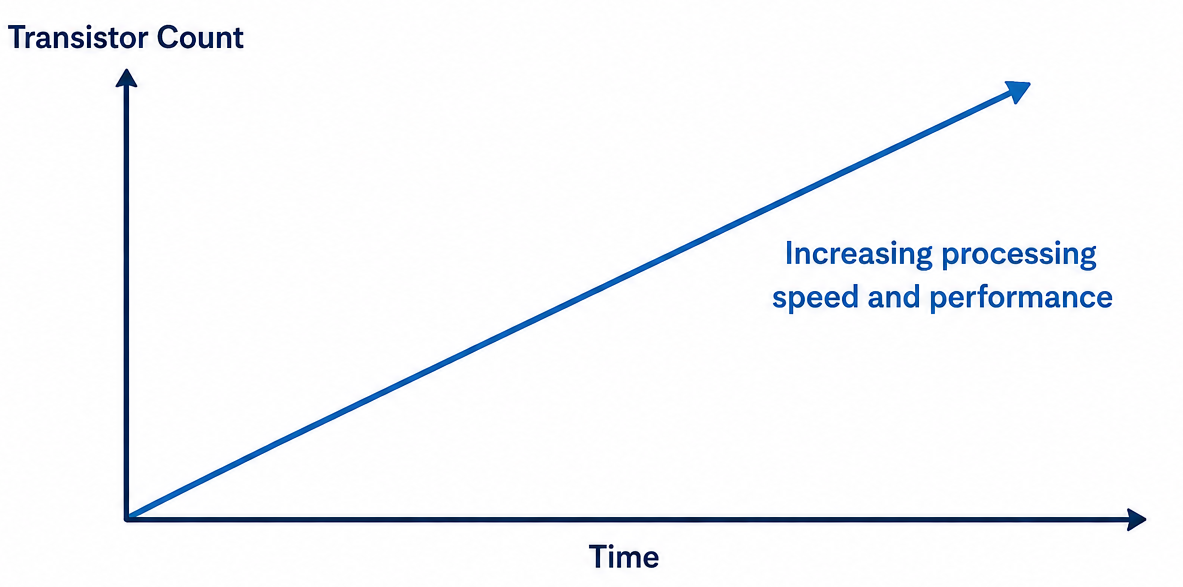
Like with computers, a term used often when describing technology breakthroughs, is Moore’s Law.
Moore's Law principle states that since the number of transistors on a silicon chip roughly doubles every two years, the performance and capabilities of computers will continue to increase while the price of computers decreases. It is a prediction made by American engineer Gordon Moore in 1965.
Part two of this series will tell the story about how lighting in general, and Sylvania, in particular, was forced to adapt to the explosion of LEDs and how it changed an entire industry.
